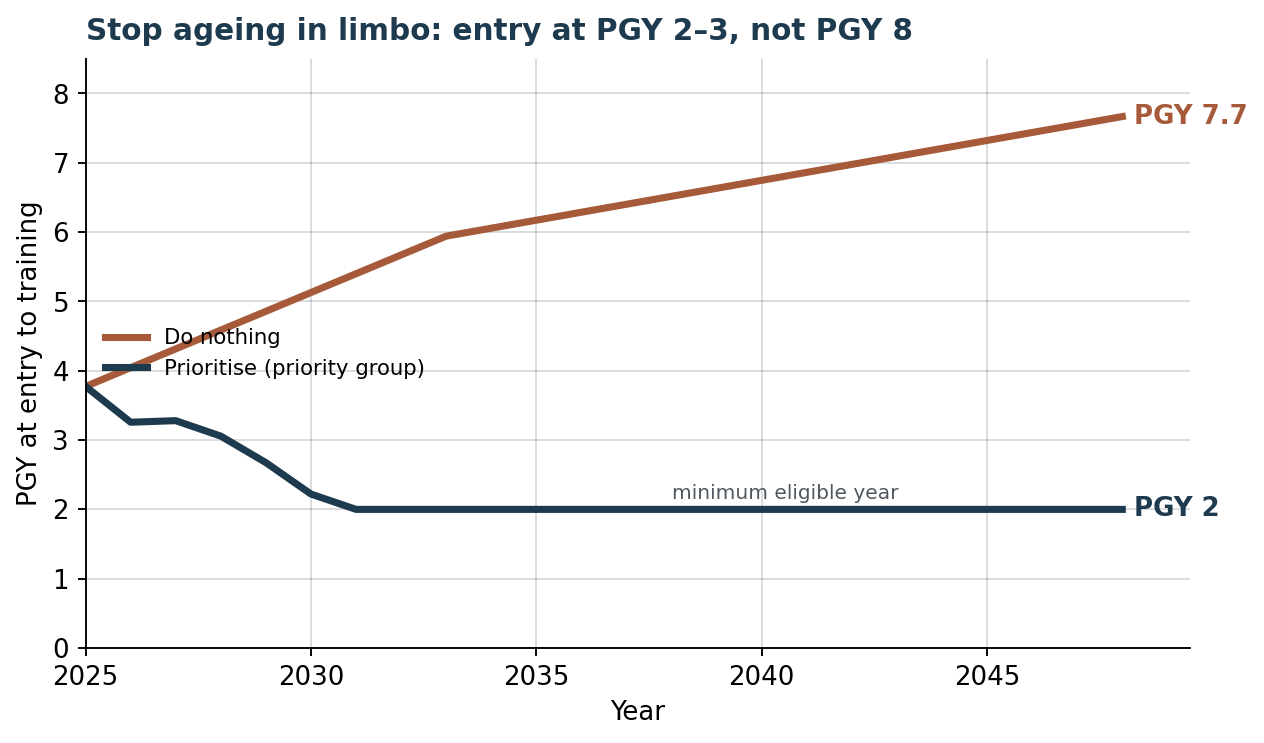
We spent six years and hundreds of thousands of public dollars becoming doctors. Now the government's own 2026 workforce report says most of us will wait close to a decade to train as specialists. The queue behind us more than doubles by 2048. It doesn't have to be this way.
Australia trains more medical students than ever. The number of specialty training places has barely moved. So a growing crowd of fully-qualified junior doctors competes for a near-static number of places. Progression into training has already fallen from 52% a year to 33%. The government's own modelling says it could reach 15% by 2048.
Every year, Australia registers more international medical graduates than it graduates domestic doctors. The number of training places stays flat.
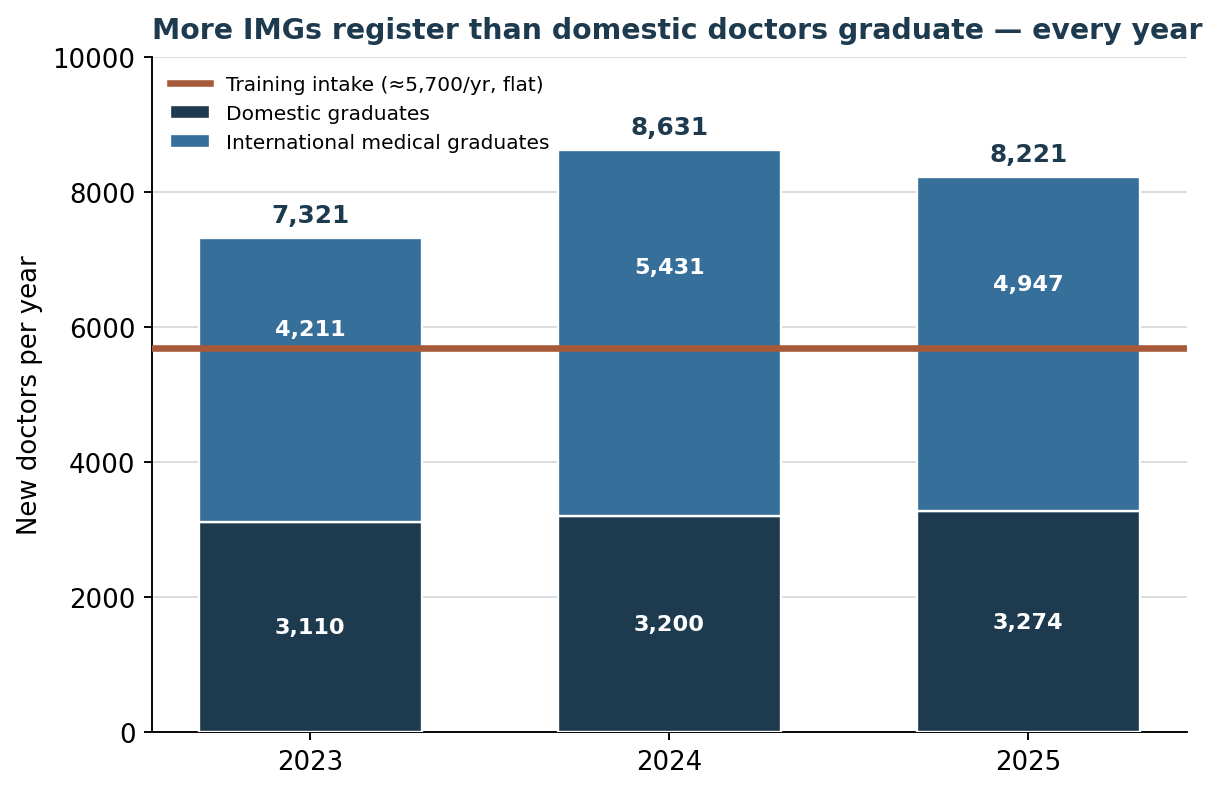
This is not about individual international doctors. They are our colleagues and our friends. Rural Australia depends on them. Our target is a policy choice: a government that recruits past a queue of graduates it already paid to train, instead of building the training places that would let everyone through. The fair fix sends overseas recruitment where it is genuinely needed. It does not punish the doctors already here.
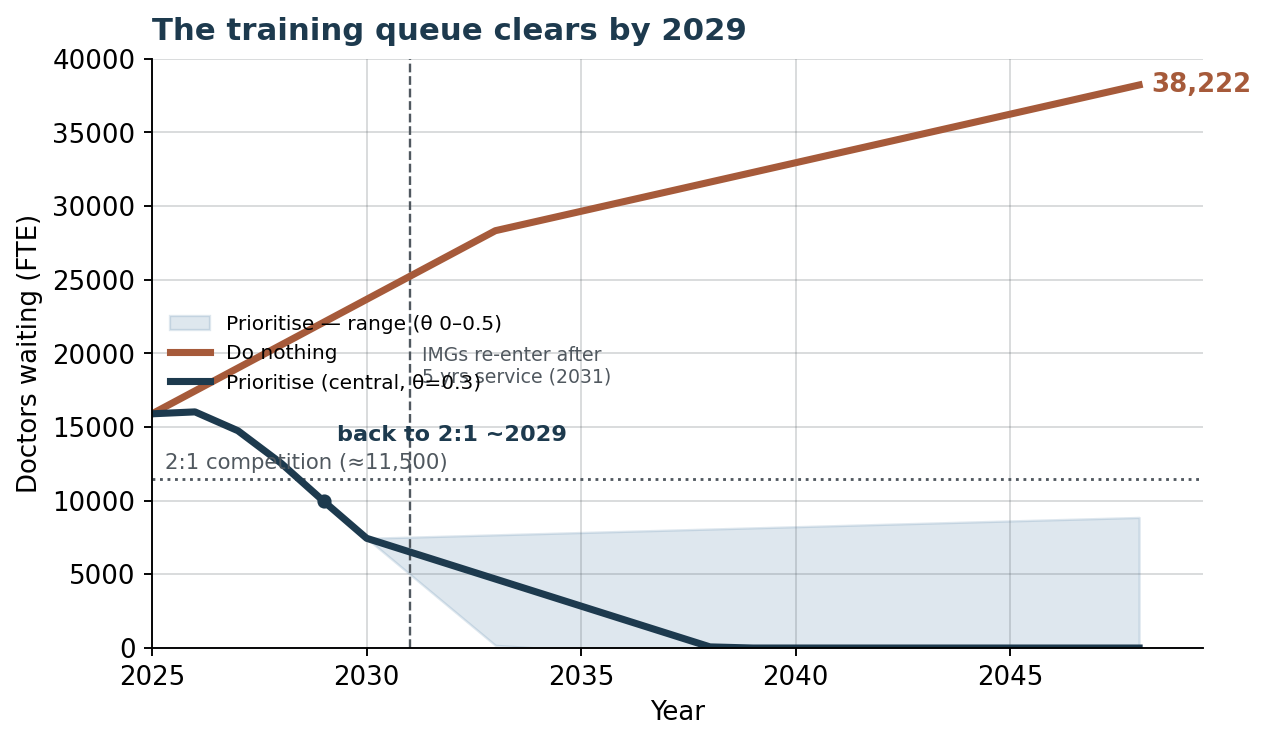
The NSWMSC workforce model runs the government's own numbers forward under two scenarios: do nothing, or prioritise the graduates we've already trained (with overseas recruitment directed to real need). These are illustrative projections from that model.
Behind every figure is a doctor who did everything right and is still waiting. Here is what the bottleneck feels like from inside it.
Britain hit the same wall. Too many home-grown graduates. Too few training posts. Overseas recruitment filling the gap. Then it changed one rule: prioritise home-trained doctors, and direct overseas recruitment to genuine need. In a single round of applications, competition ratios halved.
Give the doctors Australia already trained first access to specialty training places. Judged on where they trained, never their nationality. Everyone already practising here stays fully protected. Modelled on the UK reform.
Expand accredited specialty training capacity so more qualified graduates can actually progress, rather than stacking up behind a static gate.
Send international recruitment to the rural and area-of-need roles that actually need filling. Supplement our workforce. Don't substitute for training our own.
Hold off on new medical schools until training capacity catches up. More graduates into a blocked pipeline just widens the bottleneck.
Restore independent national medical workforce planning, so a bottleneck like this can never be allowed to build again.
Add your name to the open letter, explore the modelling, and share the campaign. It's how a queue that doubles by 2048 becomes a queue that clears by 2029.